


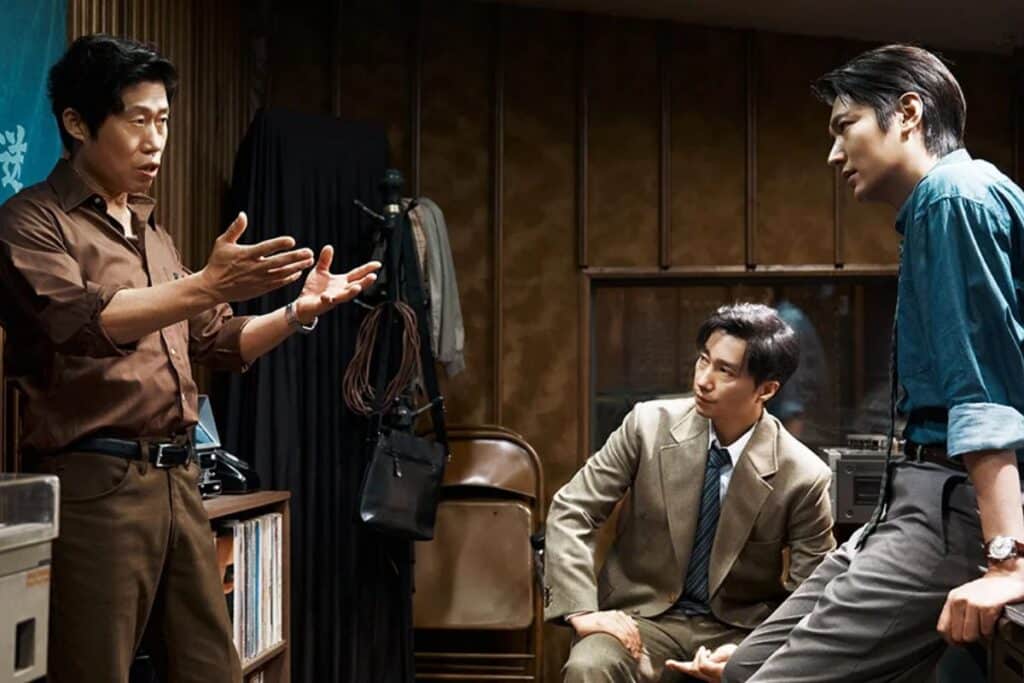
SHIFTER’s Chris Harrison calls Korean director Hur Jin-ho’s latest “a snappy, compelling story” in his The Assassin(s) film review.
“The Assassin(s) is a snappy, compelling story of corruption and the power of journalism in an age of suppression and censorship.” – Chris Harrison
The Assassin(s) is a snappy, compelling story of corruption and the power of journalism in an age of suppression and censorship.
The story is based on the real-life assassination attempt on South Korean president Park Chung-Hee in the 1970s by the Korean-Japanese Moon Se-Gwang in 1974, which resulted in the death of the first lady and an innocent child, after which the president eerily continued his speech. Pro-government rallies and calls to execute Moon soon followed, shifting public sentiment towards the military dictatorship. The investigation was swift and incomplete, with a tidy statement released by the government that ran counter to independently collected evidence, as well as investigations in Japan. Much as the film’s title suggests, the central mystery here is whether or not Moon acted alone, with a team of reporters collaborating with local police officer Park Cheol-Gu (Yoo Hae-Jin) and uncovering key information that casts doubt over the official narrative.
Much like any newsroom movie, there’s a bit of fun to be had here as the the story grows — muckraker Kim Jae-Hwan (Park He-Il) is full of conviction from the start and questions interview subjects with real panache, and even lazy “nepo boy” Han Young-Il (Lee Min-Ho) dives head-first into danger, flying to Japan to track down leads. And there’s no shortage of danger. State agents are closely monitoring the newspaper and threatening to shut it down, while Park’s police unit is also subject to strict supervision after the shooting happened on their watch (though through no fault of their own). In this world, threats are not made with bureaucratic red tape; they’re made with fists, and baseball bats, and steel pipes, which ups the stakes considerably. Everyone in pursuit of the truth here is truly playing with fire, and everyone who stands up for themselves is in for a beating (or two, or three).

That sense of immediacy ups the stakes. The threat of one of the reporters being killed is palpable, the roadblocks in their way often feel insurmountable, and the world they’re trying to upend is characterized by a powerful inertia. You can see how it wears on each character, but also how it excites them — Lee Min Ho’s particularly great as Han becomes more resolute and fights for the truth in a case that quickly reveals itself to be much bigger than it seems, encompassing everything from Japan-Korea relations, anti-communist sentiment, and even the foundation of the railroad system.
One of the pivotal scenes late in the movie may be a bit over-the-top (the free press declaration, based on a real event, feels more like something out of an action flick) but it’s powerful nonetheless, due at least in part to Park He-Il’s performance. For all its inspiration, though, the film is quick to contrast the aims of the movement with the results of the real-life case (cut with actual footage, to great effect). Their vision of a free press came to be, but there’s always a greater power in the way. More than 50 years later, we still don’t have all the answers.

Related content:
TV REVIEW: SOLID BUT UNSPECTACULAR AMERICAN HOSTAGE BUOYED BY CHARISMATIC JON HAMM