


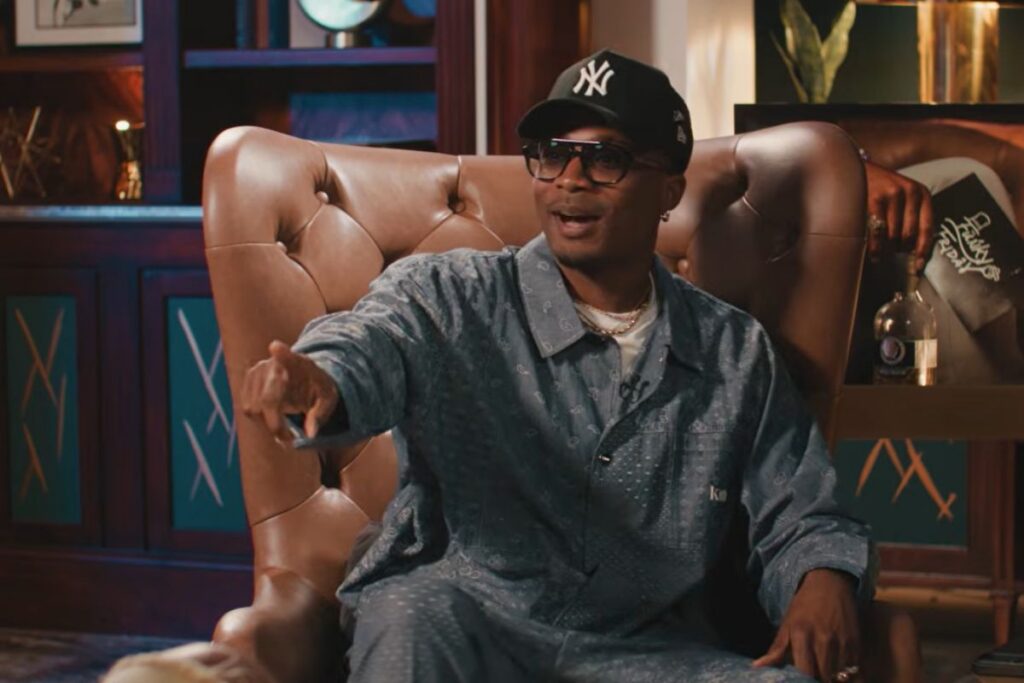
In light Haitian-American actor Da’Vinchi’s controversial appearance on Cam Newton’s Funk Friday podcast, Kevin Bourne asks if Black people need to get over slavery.
“It’s unfortunate that we have so many people in the word that can’t see past that [slavery]…I can understand the emotions that it conjure up because of what people of African descent have gone through under the hand of Caucasians, but however the story is much bigger.” -Da’Vinchi
Haitian-American actor Da’Vinchi has been in the headlines over the past few days and for all the wrong reasons.
He was recently on former NFL quarterback Cam Newton’s “Funky Friday” podcast where they got into a discussion that sparked some controversy. According to news headlines, Da’Vinchi called Black Americans “lazy” and lacking work ethic, but that isn’t exactly what he said. Just a case of broken telephone. Or people seeing a clip without watching the whole interview. I would expect as much in a time when fact-checking is a lost art.
Newton asked Da’Vinchi whether he felt a certain way when British actors like Damson Idris and Idris Elba land prominent roles portraying Black American characters. After stating that he initially was taken aback, he realized entertainment is a business. He then added, “I do think the work ethic of Americans is something that people in a higher position, it’s harder for them to trust it.”
Damn.
Are Black Americans lazy?
He went on to add that humans on a whole are becoming more and more incompetent, especially with the increased popularity of AI, and that America is babying its children. He later summarized Americans’ work ethic as “very lazy and poor” while he attributed his personal work ethic to growing up with his Haitian grandparents and learning how to take care of himself at an early age. He also added that producers might want a foreign actor who is more focused and less into being a celebrity or influencer.
Damn again.
These comments were scathing, and I could see why Americans on a whole would find his comments offensive, but Black Americans?
This is where the conversation took a turn. When Newton asked whether some Black people from the Caribbean, Africa and the United Kingdom believed they were superior to Black Americans, Da’Vinchi replied, “I think that’s true.”
He followed it up by adding, “Look, I don’t think it’s right.”
So why exactly are some Black folk offended? Because it’s a sign of the times. Being offended is in style–like oversized pants and shaped outerwear. There’s no appetite for context, mature discussion, agreeing to disagree, or giving people the benefit of the doubt. Let’s just air out people for the fun of it. If I were to ask how many people who are alarmed actually watched the full interview, I bet the numbers would be low. But that’s the nature of media and public discourse in 2026.
Do African and Caribbean people think they’re superior?
Now, putting the interview in context, Da’Vinchi didn’t specifically call Black Americans lazy or lacking work ethic, nor did he agree with Black people from the Caribbean, African or UK who may think they are better than Black Americans. He merely went on to explain why some members of the Black diaspora from Caribbean, African or UK would think they are superior.
One issue in this whole fiasco is that Da’Vinchi lives in two worlds, which is why he provides an interesting perspective. As he said in the interview, at home, he was Haitian and in the world, he was American. This is why he referred to Americans as both “you guys” and “we” during the interview. He has the lived experience of both a Haitian and an American.
“…things are very sensitive in the Black Diaspora right now; maybe too sensitive. Relations between Black Americans and other subsections of the Black diaspora have never been more hostile…” -Kevin Bourne, SHIFTER
But the other issue is that things are very sensitive in the Black Diaspora right now; maybe too sensitive. Relations between Black Americans and other subsections of the Black diaspora have never been more hostile, at least on social media. Threads and X are full of posts from “Foundational Black Americans” who feel disrespected by African and Caribbean people by ignoring Black America’s contributions to American and global culture. Meanwhile, some African people have accused Black Americans of having no culture at all.
Where did these diaspora wars begin? They were aways there festering, but the Kendrick Lamar vs. Drake beef definitely didn’t help. The popularity of “Not Like Us” was a pivotal moment that sowed the seeds of division, or better yet, watered them.

“…both Da’Vinchi and Charlamagne made valid points. The problem is they were having two completely different conversations.” -Kevin Bourne, SHIFTER
Slavery: Is it time to move on?
Now the other part of the conversation that initially flew under the radar but is now gaining attention are Da’Vinchi’s comments on slavery.
“It’s unfortunate that we have so many people in the word that can’t see past that [slavery]…I can understand the emotions that it conjure up because of what people of African descent have gone through under the hand of Caucasians, but however the story is much bigger.”
This led Charlamagne the God to name Da’Vinchi the Donkey Of The Day on The Breakfast Club, but in my opinion, both Da’Vinchi and Charlamagne made valid points while failing to see the other perspective. The problem is they were having two completely different conversations.
Charlamagne was right in that slavery didn’t happen that long ago. My daughter is a reminder of that. She’s light-skinned and has the hair texture of a biracial person despite being six generations removed from slavery and having a dark-skinned mother. And if someone can show physical traits of slavery six generations removed from slavery, is it not possible that there are still mental and emotional traumas that still linger? Yes. Plus as Charlamagne noted, the systemic racism in the United States, including policies, that disenfranchised Black people, are still relatively recent.
“Getting over slavery means no longer feeling angry and not letting it hold you back mentally and emotionally. It’s possible to remember slavery while still moving forward.” -Kevin Bourne, SHIFTER
And this is why I say Da’Vinchi and Charlamagne were having two completely different conversations. Da’Vinchi went on to note, “Caucasians have enslaved Caucasians. Black people have enslaved Black people.” Da’Vinchi was talking about a global context while Charlamagne was speaking specifically about the Black American experience, so yes, the two were worlds apart and not talking about the same thing at all.
The miscommunications continue on social media where Black folk are getting upset that Da’Vinchi would tell them to forget about slavery. One commentor asked why Jewish people are never told to forget about the Holocaust while Black Americans are told to forget slavery. That’s not what he said.
Getting over slavery means no longer feeling angry and not letting it hold you back mentally and emotionally. It’s possible to remember slavery while still moving forward. And while I acknowledge that there are still lingering effects of slavery, especially when it comes to relationships between Black men and women, fathers and sons, and mothers and daughters, the lack of generational wealth, and the methods of coping that some Black people turn to, as an empowered person, I don’t care for the narrative that slavery has any power to hold me, or us, back. I also believe that if Black people were to unify and press forward, especially economically, we could overcome any lingering effects of slavery and systemic racism. Progress doesn’t start with white society seeing the error of their ways; it starts with us.
Even if you want to bring up the Jewish community, I don’t think any of them have forgotten about the Holocaust, but they also haven’t let it hinder them from prospering as a people. They haven’t forgotten, but they’ve moved forward.
Meanwhile, there are some in the Black community who can’t seem to find any peace until reparations are paid, or governments make it right. But what if reparations never come? And even if reparations are paid, will that even truly make things right?
“The biggest obstacle to Black progress in 2026 isn’t white society or them not making it right; it’s whether or not we will allow ourselves to move forward mentally, emotionally, and economically as a people” -Kevin Bourne, SHIFTER
The end goal? Empowerment
Overall, discussions like these, and the current climate of hyper-sensitive diaspora wars, are pointless. The biggest obstacle to Black progress in 2026 isn’t white society or them not making it right; it’s whether or not we will allow ourselves to move forward mentally, emotionally, and economically as a people, in the face of them not making it right. Anything less is not true empowerment.
Kevin Bourne is SHIFTER’s editor-in-chief and Senior Arts & Entertainment Reporter focusing on film & TV, music, and fashion. He was named one of 340 international voters for the Golden Globe Awards and a Tomatometer-Approved Critic by Rotten Tomatoes.


Related content:
OPINION:THE WEST OWES AFRICA AND THE CARIBBEAN AN APOLOGY…AND REPARATIONS