


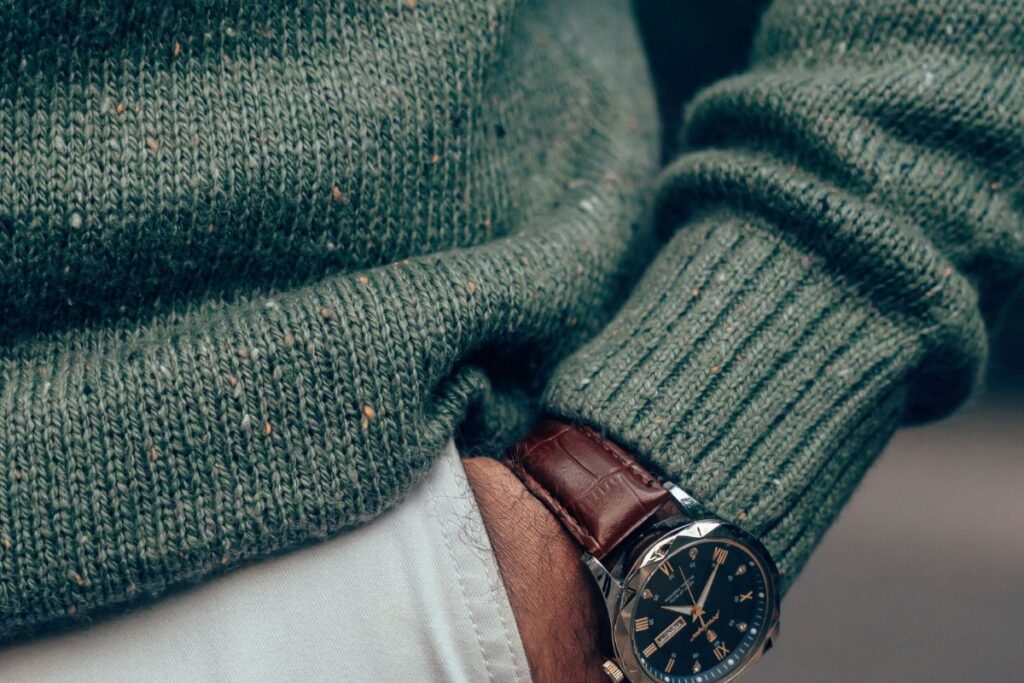
While shoppers tend to focus on silhouette, the fabric label and proper sweater care are not to be ignored.
Most men shop for sweaters the way they shop for t-shirts: by color, then by fit, then maybe by price. The fabric label gets a glance at best, which is a mistake, because two sweaters can look nearly identical on a hanger and behave completely differently after a single winter. One holds its shape, resists pilling, and still looks sharp three years later. The other stretches out at the cuffs within a month and ends up at the back of a drawer. The difference almost always comes down to what’s actually written on that small tag most people never bother reading.
Before adding another sweater to a wardrobe out of habit, it’s worth actually browsing a proper Men’s Sweater selection with fabric composition in mind rather than just color and cut. Wool is the baseline worth understanding first, since it covers the widest range of weights and price points. Fine merino wool is soft enough to wear directly against skin without irritation, breathes well enough to handle indoor heating without overheating, and holds a crisp shape through repeated wears in a way that cheaper acrylic blends simply can’t match. It’s the fabric doing most of the actual work in a well-built sweater, even when a flashier material gets top billing on the label.
“None of these materials is objectively superior to the others. The right choice depends entirely on the season, the climate, and what the sweater is actually being asked to do.”
Cashmere is where things get more complicated, and where a lot of buyers get misled by marketing rather than substance. Genuine cashmere is warmer per ounce than wool and noticeably softer against the skin, but it’s also more delicate and needs more careful handling to avoid pilling and stretching. A sweater blending cashmere with a small percentage of wool or nylon often outperforms one made from cashmere alone, since the blend adds structural resilience that pure cashmere lacks on its own. Reading past the word “cashmere” on a label to see what else is in the blend tells you far more about how the sweater will actually wear than the marketing copy ever will.
Silk shows up less often in sweaters, but when it does, it’s usually there to add a subtle sheen and a cooler hand feel rather than warmth. Cotton-silk blends work well for early autumn or for climates that rarely see genuinely cold weather, since they layer easily without the bulk of a heavier wool piece. None of these materials is objectively superior to the others. The right choice depends entirely on the season, the climate, and what the sweater is actually being asked to do, which is exactly why it’s worth reading the fabric composition before checking the price tag.


What Separates a Well-Sourced Sweater from an Ordinary One
Fiber origin is a detail most shoppers never think to ask about, but it explains a surprising amount of the price difference between two sweaters that otherwise look similar. Wool from certain sheep breeds and regions is consistently finer and softer than generic wool, which is why fiber sourcing gets mentioned at all rather than treated as an interchangeable commodity. Suitsupply’s knitwear collection, for example, draws on Australian Merino wool, Mulberry silk, and Mongolian cashmere, three materials each chosen for a specific reason rather than simply being whatever was cheapest to source that season. Australian Merino is prized for its fineness and softness against skin, Mulberry silk is the higher grade of silk fiber compared with wild varieties, and Mongolian cashmere is generally considered some of the finest cashmere available due to the harsh climate the goats are raised in, which produces a denser undercoat.
None of this is decoration. Fiber quality directly determines how a sweater ages, and it’s the reason two garments made from the same general material category can perform completely differently after a year of regular wear. A sweater built from higher-grade fiber resists pilling longer, holds its shape through more wash cycles, and generally feels noticeably softer against the skin from the very first wear rather than needing to “break in” the way lower-grade wool sometimes does.
“Fiber quality directly determines how a sweater ages.”
Construction technique matters alongside fiber quality, though it gets less attention since it’s harder to see in a product photo. Precise shaping at the shoulder and a knit density that holds structure at the ribbing rather than going slack after a few wears are both signs of a sweater built with actual quality control rather than mass production shortcuts. A sweater that fits cleanly through the shoulder on day one and still fits the same way a year later has usually had more attention paid to its construction than one that was simply cut to a standard block size and shipped.
Price is a reasonable proxy for all of this, but not a perfect one. Two sweaters at similar price points can use very different grades of the same fiber, which is why checking the specific material description, rather than just the broad category on the label, is worth the extra thirty seconds before buying.


Getting the Most Out of Wool, Cashmere, and Silk Blends
Care requirements shift depending on which fiber dominates a sweater, which is another reason the fabric label matters more than most buyers assume. Pure wool sweaters tolerate a gentle machine cycle in cold water reasonably well, provided the agitation setting is kept minimal. Cashmere is less forgiving. Hand washing in cool water with a wool-specific detergent is the safer option, since even a gentle machine cycle can cause enough friction to felt the more delicate cashmere fibers over repeated washes.
Drying technique matters regardless of fiber type, but the stakes are higher with finer materials. Wool holds a surprising amount of water, and hanging a wet sweater lets gravity stretch it permanently, usually starting at the shoulders. Laying any wool or cashmere sweater flat on a towel and reshaping it gently before it dries protects the garment far better than hanging ever could, and this single habit prevents more damage than nearly any other care step.
“Storage rounds out proper sweater care, and it’s the step most commonly skipped.”
Pilling is inevitable with natural fibers over time, but it’s manageable rather than a sign of a defective sweater. A fabric comb or a dedicated pill remover used every few wears keeps the surface smooth without wearing down the fibers underneath, and it’s a five-minute habit that keeps even a heavily worn sweater looking presentable. Skipping this step lets pills accumulate to the point where they become visible from a distance, which ages a sweater far faster than the fabric itself actually does.
Storage rounds out proper sweater care, and it’s the step most commonly skipped. Folding rather than hanging prevents the stretching at the neckline and shoulders that a standard hanger causes over months of storage. For off-season storage specifically, cedar blocks or lavender sachets placed among folded sweaters protect against moths, which are drawn specifically to natural fibers left undisturbed in dark spaces. None of this takes more than a few minutes, but it’s the difference between a sweater that earns its price back over several winters and one that quietly ends up donated after a single season of neglect.
Related content:
DSQUARED2 FALL-WINTER 2026 COLLECTION IS HIGH-FASHION CANADIANA